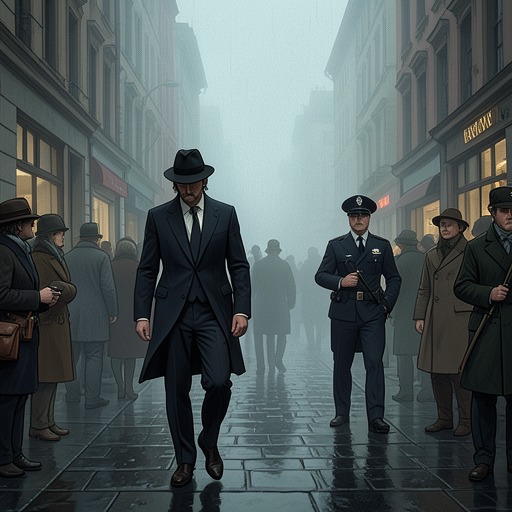
Lebel raids the Gap hotel but finds the Jackal gone
The Day of the JackalLebel raids the Hotel du Cerf but finds The Jackal gone: the operation’s first major physical search ends not in an arrest but in a room already emptied by a change of plan. The failure forces the investigators to abandon the hotel as their immediate lead and pursue the car The Jackal has driven away in. Its significance lies in the contrast between the police’s newly concentrated powers and the narrow, delayed clues on which the chase still depends.
Identification and the search
Lebel’s pursuit begins with a problem of almost complete uncertainty. After reading the report that triggers his assignment, he is given extraordinary authority: he may establish his own office, obtain the information he needs, draw on the resources represented at the briefing, and incur whatever costs are required. He responds by making the investigation operational. Lucien Caron becomes his confidential assistant as well as secretary; the office is equipped for continuous work, with outside telephone lines, a camp bed, washing supplies, and coffee. The arrangements are practical, but they also underline the case’s secrecy: no one else is to be admitted to it.
The first international inquiries reveal how little the police can offer other forces. Lebel cannot present a formal request based on an established offence, because investigators do not yet know whether the assassination plot has advanced to preparation. He has neither the suspect’s name nor a reliable description. What he can say is that the unidentified man must be a leading professional political assassin with successful killings behind him. The silence that follows this description makes the stakes legible without giving the investigators a face to pursue: there is only one target in France likely to attract such a killer.
Records eventually provide a name to test. An archive card shows Alexander James Quentin Duggan entering France on the Brabant Express from Brussels on July 22, then leaving Paris for Brussels on the Etoile du Nord Express on July 31. A hotel registration near the Place de la Madeleine records a stay from July 22 through July 30 and carries a passport number matching information from London. Rather than storm the hotel, Lebel visits quietly in the early hours; he learns that Duggan was no longer there by August 15. That earlier caution contrasts with the later, urgent raid in Gap: in both cases the police are reconstructing a moving suspect from records and testimony, but now the risk of losing him has become immediate.
The raid in Gap
At 4:50 p.m., Lebel reaches the Hotel du Cerf after being driven to its entrance in a police car. Caron accompanies him with a loaded, cocked MAT 49 submachine carbine concealed beneath his mackintosh, his finger on the trigger. The hotel has been isolated for five hours. By then, almost everyone in town knows that something is happening, yet the proprietor has remained unaware; the only conspicuous irregularity has been that the trout-seller has not arrived with the day’s fresh catch.
The proprietor comes from his accounts when summoned by the desk clerk. Lebel watches him answer Caron’s questions and notices him glance nervously at the unusual bundle beneath Caron’s arm. Then the proprietor’s shoulders sag. Five minutes later uniformed police flood the hotel, question the staff, inspect the bedroom, and search the grounds. The scale and speed of the response do not improve its result. Lebel walks alone into the drive and looks towards the surrounding hills; when Caron asks whether The Jackal is really gone, Lebel says that he is.
The distinction between a false lead and a missed opportunity matters. Caron wonders whether the proprietor is involved, but Lebel rejects that explanation: neither the proprietor nor the staff is lying. The Jackal had been booked for two days, yet changed his mind sometime that morning and left. The raid does not uncover a hidden accomplice or establish how the police were anticipated. It establishes only that the suspect was at the hotel, or expected there, and that the investigators have arrived after his departure.
From the hotel to the road
With the room and its occupants offering no further lead, Lebel identifies the car’s registration as the one actionable clue. He orders an all-stations alert for a white Italian Alfa Romeo, number MI-61741, and warns that its occupant is believed armed and dangerous. The order also controls what the police may say: the information must not reach the press, and officers must not let The Jackal learn over the radio or from a newspaper that he is suspected. Lebel’s concern is not merely to locate the car; it is to keep the fugitive from understanding how much the investigation has discovered.
The danger is visible in the surrounding movement. In a village, The Jackal’s blue Alfa waits as a convoy of four Citroën police cars and six Black Marias races past in the opposite direction. Helmeted police with submachine guns sit behind the vans’ wired windows. Once the convoy has passed, a traffic officer signals that the road is clear, and The Jackal drives on. The image captures the imbalance of the pursuit: a large force can be moving through the countryside while the intended target remains unidentified to the local officer who lets him continue.
The car’s route carries the chase south through Valence. It crosses the Rhône by the bridge towards the RN533 and St Peray, then turns into the mountains beyond Le Puy. At the Hotel du Cerf, Lebel has lost the chance to intercept The Jackal at a fixed address; after the raid, the investigation must instead turn the car’s passage and eventual disappearance into a map of possible movements.
Consequences for the investigation
The later search around Ussel shows both the reach and the limits of Lebel’s command. He directs Commissaire Valentin to assemble the strongest available team, begin at the place where the car was found, and conduct a square search of the surrounding area. Officers are to ask at farmhouses, shops, cafés, hotels, and woodcutters’ shacks about a tall, blond English-born man who speaks good French, carries three suitcases and a handgrip, and has substantial cash. The press is to be diverted with a fabricated car-crash explanation, and, if the suspect is found, the police are to surround him rather than approach.
Investigators then reason backwards from the transformed car. The paint needed to alter it may have been bought in Gap; if the car had already been repainted on its overnight journey from Gap to Ussel, that would suggest The Jackal had received a warning. A separate discovery—that his identity as Alexander Duggan had been exposed—gives the police reason to suspect that the larger plot has also been compromised. Lebel cannot prove that an insider supplied the information. He considers several possible routes through the police bureaucracy and suspects that Valmy may be the contact, but the conclusion remains an inference rather than a solved leak.
The hotel’s empty room therefore becomes more than a failed search. It marks the point at which an operation built around identifying and locating a suspect becomes a moving contest over information: the police have powerful institutions and a national alert, while The Jackal has already left the address they have found. Lebel later recognizes that the week The Jackal spent in France was not simply wasted time; he had chosen the day on which to strike. The raid exposes the central difficulty of the manhunt—knowing that a threat exists, and even identifying the man behind it, does not mean knowing where he is or when he will act.